

Failure to Yield Ticket in Manitoba
In Manitoba, a simple failure to yield ticket can quickly become a costly mistake. Base fines often start in the $100-$200 range before court fees and surcharges are added, and a conviction can lower your Driver Safety Rating with Manitoba Public Insurance.
That lowered DSR doesn’t just sit on your record. It can drive up your auto insurance premiums for up to two years and, when combined with other traffic violations, may even contribute to a driver’s licence suspension or mandatory safety courses.
At JUSTICEJOLT, our traffic court agents and paralegals help drivers understand the real financial impact of a failure to yield charge and the options they have to get a failure to yield ticket dismissed.
92%
Report reduced fines or charges
5
Average Rating
What is failure to yield?
In Manitoba, failure to yield is a traffic violation under The Highway Traffic Act that occurs when a driver fails to properly grant the right-of-way to other vehicles, pedestrians, or cyclists, creating a hazard. This offence commonly leads to intersection crashes, including T-bone collisions.
Under The Highway Traffic Act (CCSM c. H60), section 136(2) covers yielding on divided highways:
136(2) Where the other highway, at the intersection with which a driver has stopped as required under subsection (1), is a divided highway, the driver, having complied with that subsection and proceeded across the first roadway, before entering the second roadway, (a) shall yield the right-of-way to traffic on the second roadway that has entered the intersection thereof with the highway on which he is driving, or that is approaching and is so close that it constitutes an immediate hazard; and (b) shall not proceed until he can do so in safety.
In simple terms, once a driver has stopped and crossed the first part of a divided highway, they must yield to traffic on the second roadway that is already in the intersection or close enough to be an immediate hazard. The driver must wait until it is clearly safe to continue, or they risk a failure to yield ticket in Manitoba.
Examples of failing to yield in Manitoba
Examples of failure to yield include not coming to a complete stop at a stop sign (also known as “rolling” through it), turning left in front of oncoming traffic, failing to look for traffic or pedestrians at an intersection, and not yielding to the vehicle on the right at an uncontrolled intersection.
Failing to yield to traffic on a through highway
Under section 131(3), when a vehicle is emerging from a private road or private driveway onto a provincial highway, and the location is outside a restricted speed area, the driver must, before crossing the roadway boundary and within 5 metres of that boundary:
- Bring the vehicle to a complete stop.
- Yield the right-of-way to any traffic approaching on the provincial highway that is so close as to pose an immediate hazard.
- Proceed onto the highway only when it is safe to do so.
These rules apply to all drivers entering a provincial highway from private property and are intended to prevent collisions at highway entrances.
Failing to yield the right of way
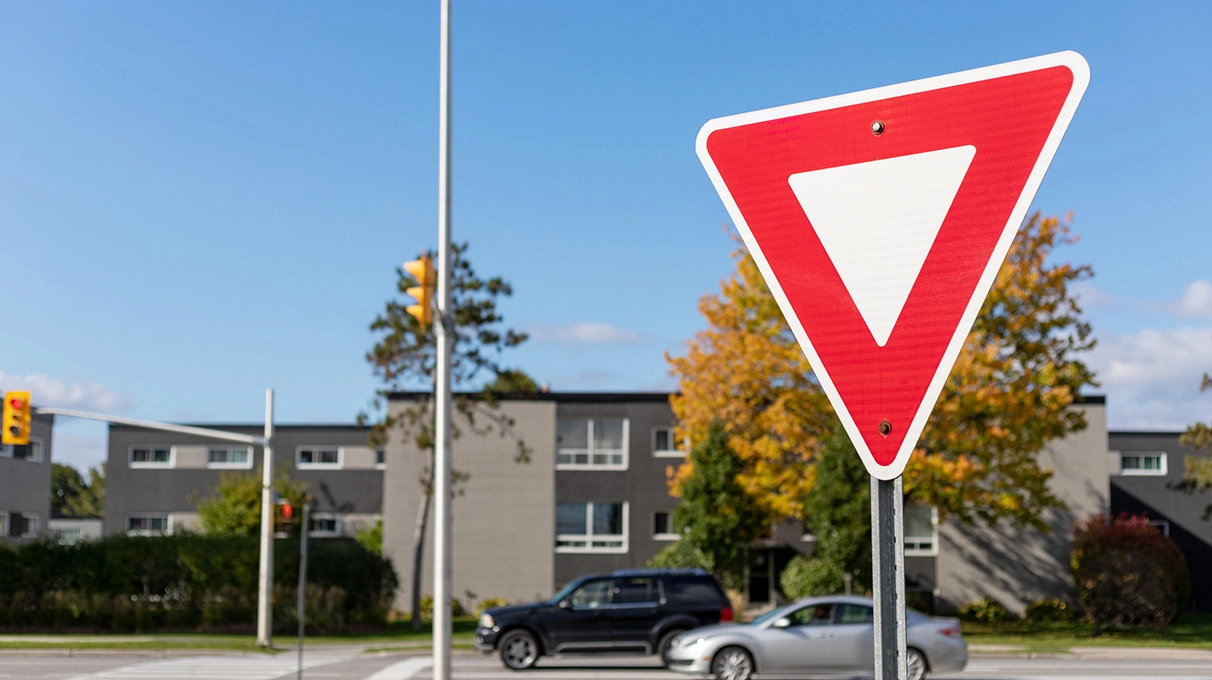
A driver approaching a “Yield” or “Cédez le passage” sign at or near an intersection must reduce speed to a level that is reasonable and safe for the current road and traffic conditions.
If necessary for safety, the driver must come to a complete stop; otherwise, they can be charged with a failure to yield ticket.
The driver is required to yield the right-of-way to:
- Any pedestrian crossing the roadway that the driver is using.
- Any vehicle already in the intersection, or any approaching traffic on the intersecting roadway that is close enough to pose a hazard.
Once the driver has properly yielded, they may proceed with caution, ensuring that doing so does not endanger pedestrians or other road users.
Fail to yield to pedestrians
Under 139(1) Subject to section 140, when traffic control signals are not installed or not operating, and a pedestrian is crossing a highway within a marked or unmarked crosswalk, the driver of a vehicle must yield the right-of-way to the pedestrian in the following situations:
- The pedestrian is on the half of the highway on which the vehicle is travelling.
- The pedestrian is approaching from the other half of the highway and is so close that the pedestrian is in danger if the vehicle does not yield.
In these circumstances, drivers are legally required to slow down or stop to allow the pedestrian to cross the roadway safely. This rule clarifies pedestrian right-of-way at crosswalks when traffic lights are not in use, helping prevent pedestrian accidents and improving pedestrian safety at intersections and crossings.
Failure to yield fines, penalties, and demerit points in Manitoba
Demerit points & driver safety rating for failure to yield
A conviction for failing to yield results in 3 demerit points. These demerits can increase your auto insurance premiums and, when combined with other traffic violations, may lead to driver’s licence suspension or mandatory safety courses.
Failing to yield is a moving violation that reduces your Driver Safety Rating (DSR). A lower DSR score pushes you further into the negative range, where you pay more for both licensing and insurance.
Fines for failing to yield
Traffic fines for a failure to yield ticket vary based on the specific circumstances of the traffic violation. In many cases, base fines start at over $100–$200, plus additional court fees and surcharges.
Insurance premium insurances from failure to yield
A failure to yield conviction can lower your DSR with Manitoba Public Insurance, which often results in higher car insurance premiums.
These increased premiums can remain in effect for up to two years, or until the conviction no longer appears on your driving record.
Serious fail to yield offences
If failing to yield causes a car accident, it may be treated as a major offence. Major traffic offences usually cause a steeper drop in your DSR and significantly higher insurance costs, on top of potential civil liability for damages.
How to fight a failure to yield ticket
Fighting a failure to yield ticket in Manitoba can be complex, and a conviction can result in demerit points and higher MPI insurance premiums.
JUSTICEJOLT is a traffic paralegal and law firm focused on helping drivers challenge these tickets, protect their driving record, and reduce the impact on their insurance.
Below is how the process of how to fight a failure to yield ticket works and how our expert team of traffic court agents and paralegals can assist at each step:
Step 1: Respond within 15 days
You only have 15 days from the date you receive the ticket to act. If you do nothing, a default conviction will be entered against you, and additional fees may apply.
- Initial ticket review: We will examine your ticket for potential “fatal errors” (for example, missing name, incorrect date, no location, or missing officer signature). While minor issues (like a small spelling error) usually won’t get a ticket thrown out, more serious defects might.
- Decide your strategy: Together with a court agent or paralegal, you can decide whether to pay, seek a reduction, or dispute the charge based on the specifics of your case and your driving record.
- Initiate the dispute: If you choose to fight the ticket, JUSTICEJOLT can contact the Provincial Offences Court on your behalf to request a hearing.
Step 2: Build a strong defence
A solid defence often comes down to preparation and evidence.
- Requesting disclosure: JUSTICEJOLT will obtain disclosure of the evidence the Crown intends to rely on, such as officer notes, diagrams, and any other relevant material.
- Gathering evidence: Your legal team can help you collect and organize photos of the scene, diagrams, dash‑cam footage (if available), and witness statements to support your version of events.
- Understanding the law: Review the specific section of the Manitoba Highway Traffic Act cited on your ticket and identify potential legal or factual defences, such as visibility issues, right‑of‑way confusion, or officer observation errors.
Step 3: Professional representation
You are allowed to represent yourself, but many drivers prefer to have a professional handle the process.
- Traffic law experience: JUSTICEJOLT court agents and paralegals focus on traffic offences, including “failure to yield” charges, and are familiar with local courts, prosecutors, and common defence strategies.
- Aim to reduce or dismiss: Depending on the facts, JUSTICEJOLT may be able to negotiate a reduction of the charge, reduce demerit points, lower the fine, or seek a dismissal.
- Minimize court time: In many situations, JUSTICEJOLT can appear in court on your behalf, reducing or eliminating the need for you to miss work or rearrange your schedule.
Step 4: Attending the hearing
If the matter proceeds to a hearing, preparation is critical.
- Court appearance: You will be given a court date at the Provincial Offences Court nearest to where the incident occurred. Court agents or paralegals can appear with you or for you, depending on the circumstances and court rules.
- Presenting your case: Your legal representative will present your defence, cross‑examine the officer if appropriate, and argue why the Crown has not proven the offence beyond a reasonable doubt.
- Plea discussions: Before or on the hearing date, we can engage in discussions with the prosecutor to explore options such as pleading to a lesser offence with fewer or no demerit points, or negotiating a more favourable outcome.
Stop 5: Alternatives and next steps
Not every case needs to go to a full trial.
- Guilty with explanation: If your main concern is the fine or payment terms rather than the conviction itself, JUSTICEJOLT can help you speak to a justice of the peace to request a lower fine or more time to pay, and ensure your explanation is clearly and effectively put forward.
- Appeals: If you are convicted after a trial, JUSTICEJOLT can assess whether there are grounds to appeal to the Court of King’s Bench (for example, if there appears to have been a legal error). Appeals are technical and time‑sensitive, so professional guidance is important.
How JusticeJolt can help get a failure to yield ticket dismissed
A failure to yield conviction typically results in demerit points, which can increase your MPI insurance premiums and impact your driver’s abstract.
If you miss your scheduled hearing, you will be convicted in your absence, and a $100 penalty will be added to your fine. JUSTICEJOLT can advise you on possible remedies if this occurs.
From the moment you receive your ticket, JUSTICEJOLT can guide you through every stage, from reviewing your options and requesting disclosure to negotiating with prosecutors and representing you in court.
The goal is simple: to protect your record, reduce the consequences, and provide clear, strategic legal support for your Manitoba failure to yield ticket.
Charged with a failure to yield traffic ticket in Manitoba?
Book a free consultation with our team today to get a failure to yield ticket dismissed.